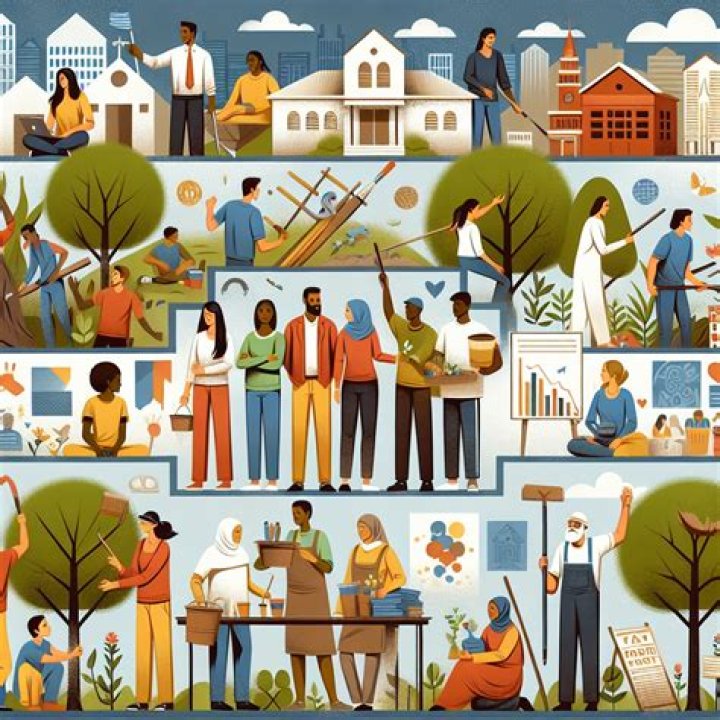
Whereas sociocultural development traces processes that tend to increase the complexity of a society or culture, sociocultural evolution also considers process that can lead to decreases in complexity (degeneration) or that can produce variation or proliferation without any seemingly significant changes in complexity ( Also, what do you understand by society?
A society is a group of individuals involved in persistent social interaction, or a large social group sharing the same spatial or social territory, typically subject to the same political authority and dominant cultural expectations.
Likewise, what is the meaning of social evolution? Social evolution is a subdiscipline of evolutionary biology that is concerned with social behaviors that have fitness consequences for individuals other than the actor. It is also a subdiscipline of sociology that studies evolution of social systems.
Additionally, what are the stages of sociocultural evolution?
In these four stages, information is passed on in this order: genetically, individually, through signs, and lastly, through symbols or language. The relationship between population and production is central to Lenski's thought.
How has human society evolved through time?
Abstract. Human society emerged over 6 million years of hominid evolution. During this time group size steadily increased, and to maintain group cohesion human beings gradually evolved a well-developed social intelligence based on the differentiation and refinement of emotions.
Related Question Answers
What is the importance of a society?
Society is the common home for all which we need from birth to death and is important to live life in a very comfortable way with participation in many societal works termed as social work for which one should fulfill his duties in order to his responsibilities. Why do we need society?
Without society the human beingwould cease to exist. Society is important because it is NATURAL to us humans and in fact MANY other animals as well. From birth, we areplaced into group settings and situations with particular common denominators: family, schools, government and political systems, etc. What are the components of society?
Context in source publicationWe can distinguish three main components: (1) the shared set of norms, values, beliefs and attitudes, (2) the created and used artefacts, and (3) the people as constitut- ing members of the society (see figure 3). These three elements relate to each other in a closed loop.
What are the essential parts of a society?
7 Most Important Elements of Society | Society - (1) Usages : ADVERTISEMENTS:
- (2) Procedures : In every society there are some procedures like modes of action which helps to maintain it's unity.
- (3) Authority: Every society has some sort of authority.
- (4) Mutual Aid : ADVERTISEMENTS:
- (5) Groupings and Divisions :
- (6) Controls:
- (7) Liberty:
What is society and its types?
In sociological terms, society refers to a group of people who live in a definable community and share the same culture. On a broader scale, society consists of the people and institutions around us, our shared beliefs, and our cultural ideas. Typically, more-advanced societies also share a political authority. What are the types of society?
The major types of societies historically have been hunting-and-gathering, horticultural, pastoral, agricultural, industrial, and postindustrial. As societies developed and grew larger, they became more unequal in terms of gender and wealth and also more competitive and even warlike with other societies. How is society created?
Societies are formed of our social groupings at varied levels, from small towns, through countries, to broader cultural groupings such as a Western society. Within such societies people tend to form particular cultures, formed of the ideas, customs, and social behaviours that make one society distinct from another. What are examples of society?
Society is defined as a group of people living as a community or an organized group of people for a common purpose. An example of society is Lancaster, Pennsylvania. An example of society is the Catholic Daughters of the Americas. What are the four stages of human societies?
An explanation of what defines a social movement is followed by a description of the development and theory of the model of the four stages of social movements. The four stages of social movement development are emergence, coalescence, bureaucra- tization, and decline. What is the second stage in the process of sociocultural evolution?
Talcott Parsons, author of Societies: Evolutionary and Comparative Perspectives (1966) and The System of Modern Societies (1971) divided evolution into four subprocesses: (1) division, which creates functional subsystems from the main system; (2) adaptation, where those systems evolve into more efficient versions; (3) What are the four stages of a civilization?
It divides the frontier process of the human civilization from the birth of humankind to the end of twenty-first century into 4 periods and 16 stages, and in which four periods include that of primitive culture, agricultural civilization, industrial civilization and knowledge civilization orderly, and each period What are the models of social change?
They also rely on three basic theories of social change: evolutionary, functionalist, and conflict theories. Who was responsible for the theory of social evolution?
Classical social evolutionism is most closely associated with the 19th-century writings of Auguste Comte and of Herbert Spencer (coiner of the phrase "survival of the fittest"). Who gave 6 stages of cultural evolution?
Morgan postulated that the stages of technological development were associated with a sequence of different cultural patterns. For example, he speculated that the family evolved through six stages. What is the evolutionism?
Evolutionism is a term used (often derogatorily) to denote the theory of evolution. Its exact meaning has changed over time as the study of evolution has progressed. The term is most often used by creationists to describe adherence to the scientific consensus on evolution as equivalent to a secular religion. What is the theory of Unilinear cultural evolution?
Unilineal evolution, also referred to as classical social evolution, is a 19th-century social theory about the evolution of societies and cultures. Different social status is aligned in a single line that moves from most primitive to most civilized. This theory is now generally considered obsolete in academic circles. What does Socio Cultural mean?
The definition of sociocultural is something that involves the social and cultural aspects. An example of sociocultural is a focus of study in anthropology. An example of sociocultural is knowing about the people around you and their family backgrounds. adjective. What are the factors that affect its social evolution?
The four key elements that affect social change that are described in this chapter are the environment, technology, social institutions, and population. Who first introduced the concept of evolution in sociology?
In the early 19th century Jean-Baptiste Lamarck (1744–1829) proposed his theory of the transmutation of species, the first fully formed theory of evolution. In 1858 Charles Darwin and Alfred Russel Wallace published a new evolutionary theory, explained in detail in Darwin's On the Origin of Species (1859). Who said where there is life there is society?
Auguste Comte
Who said society is web of social relationship?
Mac Iver
What stage according to Comte is society currently in?
Specifically, Comte suggested that global society has gone through three stages, called the theological stage, the metaphysical stage, and the scientific stage. It also covers Comte's theory of 'positivism' and how science and society interact. How communities exist and evolve?
Communities do not evolve per se; rather, they shift in composition, diversity, and structure through time. The assembly of local communities is influenced by both regional factors and local processes, each of which can influence evolutionary patterns and processes within those communities. What is mean by evolution of human society?
Instead, the concept has its roots in the Darwinian theories of origin and evolution of the species that also include human beings, or more precisely 'homo sapiens'. Evolution of a society includes development and progress not only on material grounds but more importantly in respect of human values. How long is evolution?
about one million years
Why is evolution important?
Models developed by evolutionary biologists have shed light on genetic variation that may account for an increased risk of Alzheimer's and coronary heart disease. Knowing the evolutionary relationships among species allows scientists to choose appropriate organisms for the study of diseases, such as HIV. Why do societies change over time?
Social change can evolve from a number of different sources, including contact with other societies (diffusion), changes in the ecosystem (which can cause the loss of natural resources or widespread disease), technological change (epitomized by the Industrial Revolution, which created a new social group, the urban How did prehistoric human societies evolve?
Paleolithic societies were largely dependent on foraging and hunting. While hominid species evolved through natural selection for millions of years, cultural evolution accounts for most of the significant changes in the history of Homo sapiens.